
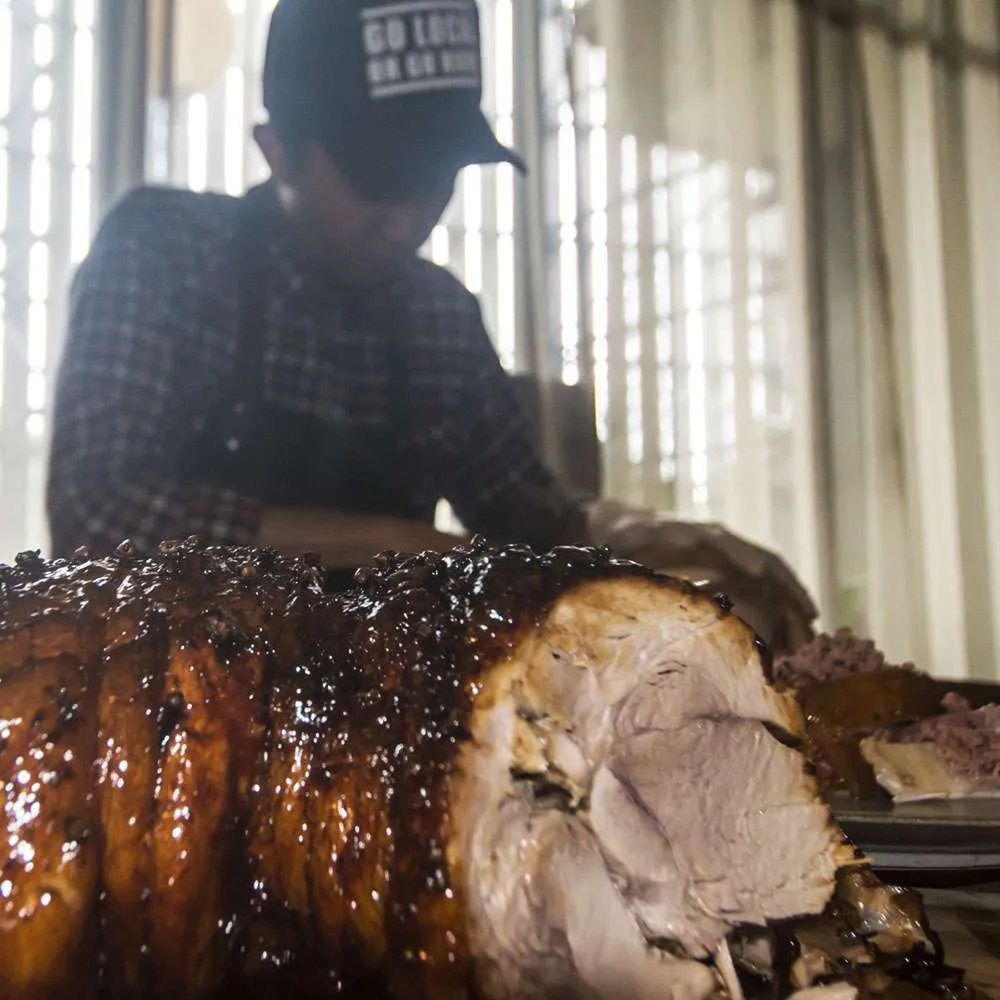
It’s not just dinosaurs and dodo birds that become extinct. Bali has its share of endangered species. The population of Bali’s iconic Bali Starling hovers at perilously low levels. About 30,000 of the unique Bali Heritage Dogs have been culled since 2009. And teetering on the brink of extinction is the delicious and culturally important heritage black Bali swayback pig, also known as the Babi Bali Asli (BBA) or Bangkal Hitam.
Until about 1985 this was pretty much the only pig around in Bali. It can be seen in early traditional paintings where it was often shown decorated during a festival, just before being sacrificed, roasted and shared by the community.
The origins of Bali’s unlovely ungulate are unclear. Some physical differences have been observed, suggesting either a variety of indigenous breeds or the introduction of a variety which arrived with the Majapahit migration. No in-depth comparative genetic studies appear to have been made. Anyway, these hypotheses may soon become academic, because the Bali heritage pig is quickly disappearing.
I was amazed; I’d never seen a black pig because nobody in my village of Tempaksiring has them in my lifetime…
– TRISNA OF WANAPRASTA
In the past 30 years it’s gradually been replaced with a white Australian hybrid which matures in 6 – 8 months as compared with a year for the Bali heritage pig. The hybrid also produces up to 12 little piggies at once compared to 4-6 for the heritage pig. Raising animals for meat is a business like any other; profits are higher when you can generate your product more quickly. And pigs fatten more speedily when confined, which is why all those pathetic white porkies live out their lives in concrete boxes, being fed processed pellets heavily laced with antibiotics.
So Balinese farmers now almost universally breed the more profitable hybrid white pig. Only the poorest farmers in a few remote parts of North Bali and Karangasem keep Bali heritage pigs. Probably just a few hundred pigs survive, and the breed could easily become extinct in this generation. A couple of small initiatives are working to prevent that
Wanaprasta is a Sanskrit name meaning ‘return to nature’. This farm cooperative seeks to improve farmers’ skills by working with nature rather than against it. The philosophy relies on the development of pure natural foods that are grown with a commitment to the natural cycle of nature rather than modern chemical shortcuts. The cooperative then seeks to represent farmers into the value added marketplace.
Jon and Trisna of Wanaprasta have been exploring Bali’s poorest areas for years, seeking farmers with traditional products for the contemporary market. “About five years ago when we were visiting a very dry area in Buleleng I saw that each family had a free range black pig. I was amazed; I’d never seen a black pig because nobody in my village of Tampaksiring has them in my lifetime,” said Tri. “I felt that I’d gone back in time 50 years. The houses had no fences between them and the pigs were wandering around like pets. They’re very hardy and easy to care for. At night they return and sleep in front of the house.”
Jon and Tri wondered how they could commercialise the black Bali heritage pig in order to prevent its extinction. They started to work with farmers, pledging to buy at least one 50 – 120 kilogram pig a week at double the market rate of the hybrid pigs. With very little capital they navigated a steep learning curve as they researched the animal and learned to process and market the meat.
The farmers were encouraged to form a cooperative, and given a clean kitchen and training to kill the pigs quickly and do the basic breakdown hygienically. The carcasses were then brought to the Wanaprasta centre near Ubud which has a processing facility built to international standards — very rare on Bali. Today about 50 farmers are involved in the project.
“It was an interesting new product, unique in the world,” said Jon, an organic farmer for many years in Australia. “But I was nervous about investing in it because it was unknown to the market. For several years it seemed like the wrong decision. Chefs were used to the look, leanness and flavour of hybrid pigs. We lost a lot of money over four years of supporting the pigs with the farmers then experimenting with charcuterie. It’s very important to find a market because the farmers are relying on us.”
Tri experimented for a long time until he created a recipe for excellent sausages and hams that are now selling well. About 40 kg of breakfast, mango and Bali spice sausage are sold weekly, mostly to Italian and French customers. Only prime meat is used in the sausages. All the offcuts and ground bones go into organic pet meat.
In 2015 the Bali black pig was boarded on the Slow Food Ark of Taste, a list of endangered animals and foods from around the world. Wanaprasta has the Slow Food Bali Snail of Approval for its ethical pork, chicken and other products.
Please visit Wanaprasta on Facebook.
Original article by: https://slowfoodbali.com/balis-heritage-pig-goes-to-market/